Civic infrastructure for human agency in the age of AI.
The operator drives. The agents ride. The commons remembers.
A Massachusetts Public Benefit Corporation. We build open standards, schemas, protocols, and focused institutional software — public goods, released under open licenses, designed to outlive any single vendor, including us.
The name is the architecture. Bus Commons stewards the common bus — the single shared line every module attaches to. Each module is a different modality; all of them ride one substrate. The bus is how they reach each other; the givens left on it are left for all.
The history of operator tooling is a sequence of new sovereignties: spreadsheets gave non-programmers computational agency, databases gave data agency, the web gave distribution agency. The next rung is cognitive agency in the age of AI — not AI that thinks for you, but a substrate where the operator’s judgment stays irreducible, AI handles the labor, and the system remembers what it learns and surfaces what’s missing.
The spreadsheet user never owned the biggest computer; she owned the arrangement. A larger model is a larger instrument, not more music. What does the work is a composed system — an operator who steers, agents that carry the labor, a substrate that remembers — and because the intelligence lives in the arrangement, you can swap any part, including the model, and it stays yours.
That’s the work. It starts with the name — because the name is the architecture.
STOP 03 · A CASE ENDING THAT ESCAPED
THE NAME
Omnibus — for all, by all.
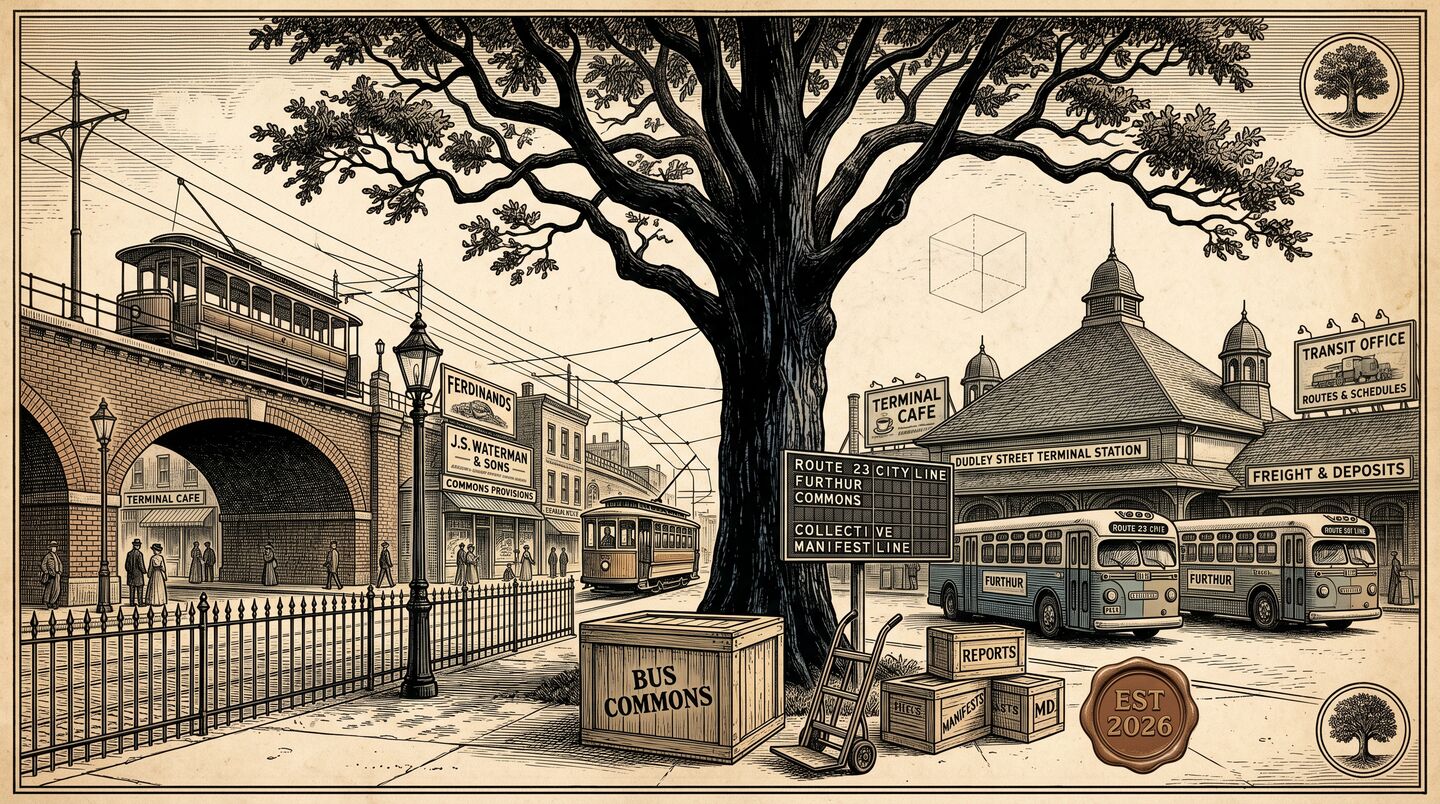
Bus is not a root — it’s a Latin case ending. Omnibus, the dative plural of omnis, “for all,” named the shared carriages of the 1820s; English kept the inflection and dropped the root. And omnibus is at once dative and ablative — “for all” and “by all,” what the bus is for and how it works.Commons is shared obligation, not shared stuff. The company is named for the bus terminus in Nubian Square, Roxbury — the old Dudley Street Terminal in the engraving that opens this page, the same ground under an earlier name.
Small, owned, built to outlive its vendor. The first instance is BUSdriver, the operator’s desk this company runs on every day.
REJOINS ROUTE 1
STOP 05 · HOW WE WORK
THE METHOD
Six commitments, posted like a timetable.
NVRNON VERBIS SED REBUSNot by words but by things: our agents coordinate like a termite colony, through traces left in a shared substrate — and the company runs on the substrate it ships. See it run: the lab.
MTHTHE METHOD IS THE PRODUCTA documented, repeatable, auditable process for finding the genuine gap; we ship only the output of that cycle.
PUBPUBLIC ARTIFACTSOur work appears in a federal docket before it appears in our marketing.
CTRTHE CONTRACT IS THE SECURITYEvery agent works to a written contract: trust by interface, not by access — everyone needed, no one necessary.
MNTTRUST IS MINTED, NOT ASSUMEDEvery secret flows through one accountable path; credentials are issued signed, scoped, and expiring, dead by default.
HRZLONG HORIZONS, SMALL TEAMSDeliberately small, building civic infrastructure that takes decades to matter, as a PBC because the work doesn’t fit the venture timeline.
STOP 06 · STRUCTURE
THE CHARTER
The legal structure is the commitment.
The infrastructure layer of the agentic economy is being built right now, mostly by entities answerable to private shareholders. Some pieces — identity, qualification, the legibility of law — should be actual public goods, with charters that survive their founders.
Massachusetts allows Public Benefit Corporations specifically to legally bind a company to its stated public mission. Bus Commons is incorporated under that statute as CUBE COMMONS, INC.; Articles of Amendment adopting the Bus Commons name are pending. Our charter requires us to weigh public benefit alongside financial returns.
STOP 07 · THE ROAD FORKS — RIDE THE PUBLICATIONS LINE →
Notes from the invisible profession · First edition · December 2023READ →
REJOINS ROUTE 1
Living list. Will grow as we publish.
STOP 08 · LINEAGE
WHO WE ARE
In the lineage of civic infrastructure.
Bus Commons (CUBE COMMONS, INC.) was founded by Barton Nicholls in Roxbury, Massachusetts, in the lineage of civic infrastructure — library science, public standards, federal records, open protocols. A Massachusetts Public Benefit Corporation. Small, deliberate, intended to last.
STOP 09 · THE ROAD FORKS — RIDE THE DOORS LINE →
WATCH THE CLOSING DOORS
Different readers, different doors.
The shortest honest path for each. Scroll right and get off at yours.
The Doors LineD1 OF 5
D1 · IF YOU’D RATHER WATCH THAN READ
The lab
The thesis, live: autonomous agents coordinating through a shared substrate, in your browser. The commons, working.
We work from Roxbury, up the hill from the Nubian Square busway — where this route, like most in this city, begins and ends. The words at the foot of this page live not on letterhead but in the signature chain — the signing engine is being fitted to carry OMNIBUS COMMUNIBUS in its signed metadata. For all, by all; all things in common.